

“Identify vulnerabilities before attackers do and safeguard your business with proactive security.”
What is API Penetration Testing?
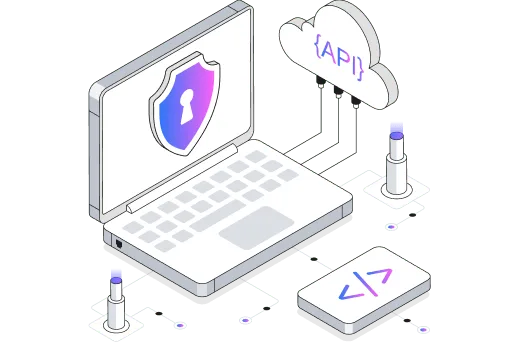
API penetration testing (VAPT) is a proactive security approach where we simulate real-world attacks to uncover vulnerabilities within your APIs. These tests help identify weaknesses in REST, SOAP, GraphQL, and microservice-based APIs before malicious actors can exploit them.
Speak with our security experts and discuss your specific testing needs.
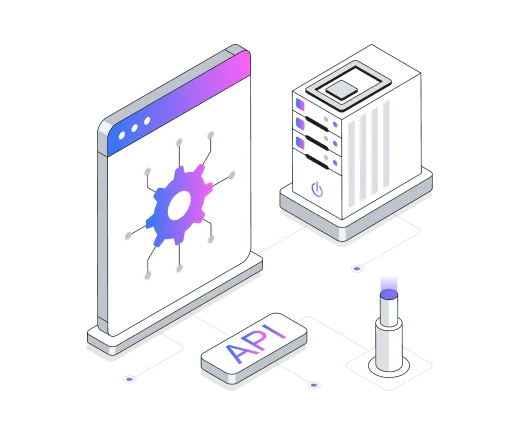
Why Do You Need API Penetration Testing?
Protect Against Data Breaches: APIs often serve as the backbone of applications and can expose sensitive data if insecure.
Meet Compliance Standards: API-driven ecosystems must meet standards like PCI-DSS, HIPAA, GDPR, and industry best practices.
Avoid Financial and Reputational Losses: Exploitable APIs can lead to full system compromise, business logic manipulation, and major financial impact.
What We Look For:
Our expert team combines manual testing and automated scanning to identify a wide range of vulnerabilities across your mobile application, based on industry-leading standards such as OWASP Mobile Top 10 and OWASP MASVS. We look for:
- M01:2025 – Improper Credential Handling
- M02:2025 – Insecure Data Storage
- M03:2025 – Insecure Communication
- M04:2025 – Insecure Authentication & Authorization
- M05:2025 – Insufficient Cryptography
- M06:2025 – Reverse Engineering & Code Tampering Risks
- M07:2025 – Insecure Platform Usage
- M08:2025 – Supply Chain Vulnerabilities in Mobile Apps
- M09:2025 – Insufficient Logging & Monitoring
- M10:2025 – Insecure Session Management & Runtime Manipulation

If you want to know how Vaptora’s Web Application Penetration Testing can secure your app, here’s what you can do next
Our Methodology
We follow a structured approach aligned with
OWASP ASVS, OWASP API Security Framework, PTES, and NIST SP 800-115. Here’s an overview
01.
Pre-Engagement Activities
- Scope Definition
- Rules of Engagement
- Required Access (API docs, endpoints, keys, credentials)
02.
Reconnaissance & Information Gathering
- Passive Recon (public docs, API metadata)
- Active Recon (endpoint analysis, schema exploration)
03.
Enumeration
Discovering endpoints, request methods, parameters, authentication flows, rate limits, and microservice architecture mappings
04.
Threat Modeling
Mapping API-specific risks including BOLA, mass assignment, business logic abuse, and privilege escalation.
07.
Exploitation & Validation
Controlled exploitation to verify the impact of vulnerabilities including unauthorized access or data manipulation.
10.
Retesting
Ensuring patched API vulnerabilities are fully resolved.
05.
Automated Scanning
Using API-specific scanners to detect misconfigurations, outdated components, and insecure headers.
08.
Post-Exploitation
Assessing multi-endpoint abuse, lateral movement, chaining vulnerabilities, and sensitive data extraction.
06.
Manual Vulnerability Testing
Validation of complex flaws such as broken authorization, token manipulation, session hijacking, injection attacks, and data exposure.
09.
Reporting & Remediation
Includes:
- Executive Summary
- Technical Findings
- Remediation Strategy

Why Choose Vaptora?
- Expert API Security Professionals skilled in REST, SOAP, GraphQL, microservices, and cloud-native architectures.
- Comprehensive Testing across authentication, authorization, logic, input validation, and infrastructure layers.
- No Disruptions to your operations.
- Actionable Reports with clear instructions for developers.